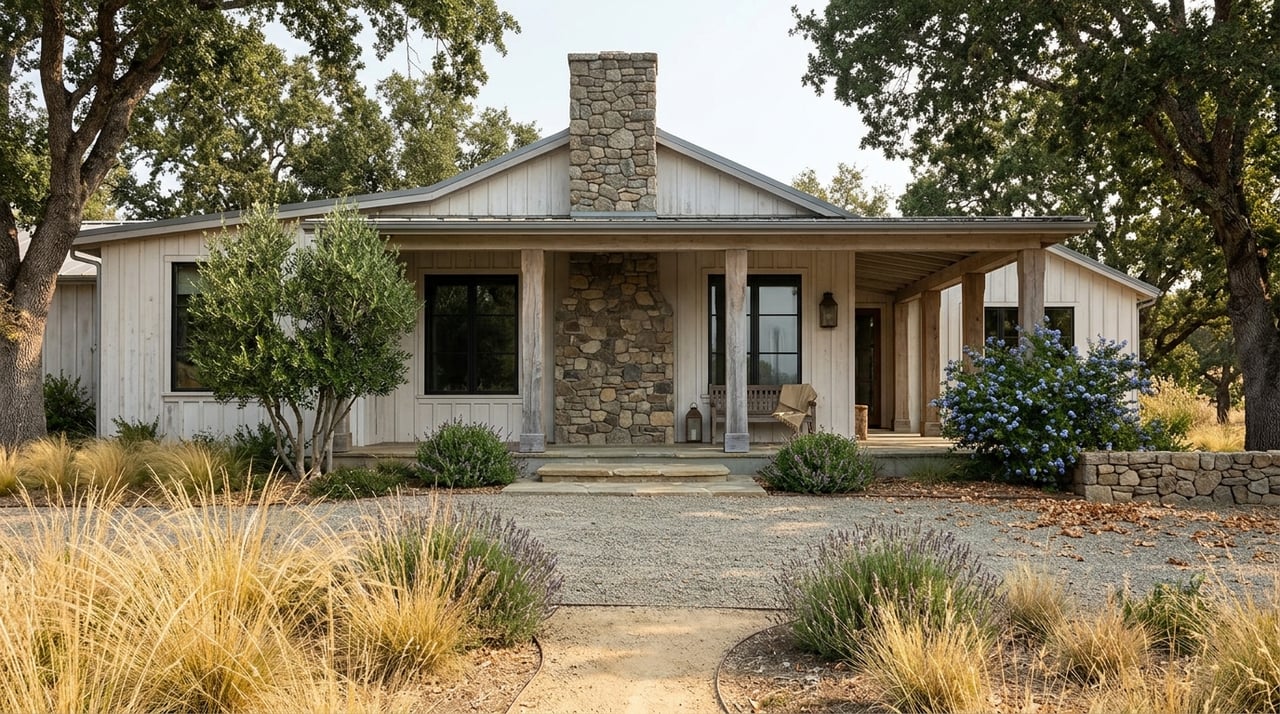
"One of the last vacant land opportunities" is how a recent Happy Canyon listing described its 11.46 acres, priced at $1,395,000, or roughly $121,728 an acre. Read that phrase twice. It is not marketing hyperbole about a hot pocket of the Valley. It is a fairly literal description of how little raw land actually changes hands here, and why.
If you have been comparing per-acre prices in Santa Ynez to what an acre costs in Montecito or along the coast, the math looks tempting. Land here can run a fraction of coastal per-acre prices. But that comparison hides the real story: in the Santa Ynez Valley, cheap land per acre and a persistently thin supply of newly subdivided residential lots are not two separate facts. They are the same fact, produced by a California tax law that Santa Barbara County's Uniform Rules for Agricultural Preserves and Farmland Security Zones describe as enacted in 1965 and that pays landowners not to subdivide, plus a second layer of permanent conservation easements stacked on top of it.
What $121,728 an Acre Actually Buys
That Happy Canyon parcel sits at the end of Stallion Drive, split across two APNs, with a well drilled to 300 feet back in 2005 and ready for agricultural or domestic use. It is being sold as bare land in a neighborhood of large equestrian parcels and ranchettes, precisely because parcels like it rarely come open for sale. Compare that to active vineyard properties currently on the market near Santa Ynez, which average roughly $290,000 an acre once producing vines and winery infrastructure are factored in. Two very different products, two very different prices, but the same underlying constraint: almost none of this ground is zoned or contracted in a way that lets a buyer split it into new residential lots.
That constraint has a name, and it shows up in the county's own tax records more often than most buyers expect.
The Contract You Inherit, Not Just the Dirt You Buy
The Williamson Act, formally the California Land Conservation Act of 1965, lets landowners contract with the county to keep land in agricultural or open space use. In exchange, the county assessor taxes the land at its agricultural use value instead of its full market value, which can mean a meaningfully lower annual tax bill for a working ranch or vineyard.
The part that catches buyers off guard is what comes with that tax break. A Williamson Act contract runs with the land. Buy a parcel under contract and you inherit both the reduced assessment and the restrictions, whether or not anyone mentioned it during your first walkthrough. Contracts run on a rolling ten-year term that renews automatically each year unless someone files a formal notice of nonrenewal, which starts a phase-out that commonly takes about nine more years to fully expire. Cancel outright, and the county can impose a penalty that has historically run around 12.5 percent of the land's full, unrestricted market value. Santa Barbara County's General Guidelines for the Agricultural Preserve (Williamson Act) Program describe the longer Farmland Security Zone option, a 20-year version of the same idea that taxes land at 65 percent of the standard Williamson Act rate.
None of this means the land is off limits to residential use entirely. A primary residence is often compatible with an active contract. What is restricted, in most cases, is exactly the thing a buyer eyeing "cheap" acreage might be counting on: splitting one large parcel into several smaller, more marketable ones.
Before writing an offer on Valley acreage, a short due diligence checklist saves a lot of surprises later:
- Get the recorded Williamson Act or Farmland Security Zone contract directly from the county, not a summary
- Confirm whether any notice of nonrenewal has already been filed, and if so, how many years remain in the phase-out
- Ask your lender early whether they have experience underwriting agricultural-assessed parcels, since appraisers need to account for the contract's restrictions
- If you plan any non-agricultural building, confirm in writing with county planning whether it qualifies as a compatible use before you count on it
Ag-to-Ag, Not Ag-to-Home
Recent transactions in the Valley reinforce how this plays out in practice. As reported by the Santa Maria Times, Groundstar Vineyard & Estate closed on the historic 247-acre Williams Ranch off Highway 246 between Buellton and Lompoc in February 2026, expanding its holdings to more than 320 contiguous acres in the Sta. Rita Hills corridor. The buyer, founded by Chiara Shannon and Joseph Brent and previously known for the 25-acre Ampelos Vineyard, plans to fold the new acreage into broader rangeland management, including regenerative grazing and expanded water systems, not new home construction.
That is the pattern worth noticing. Large Valley land sales tend to move between ranchers, vineyard operators, and conservation-minded buyers who intend to keep the ground in production. It is not that nobody wants to build here. It is that the land most likely to trade hands is also the land least likely to convert into new residential inventory.
Conservation Easements Push the Same Lever Permanently
The Williamson Act is a renewable tax contract. Conservation easements go further and take land off the development table for good. The Land Trust for Santa Barbara County has helped protect around 27,000 acres from development over more than three decades, even as the county has lost an estimated 50,000 acres of agricultural land to development since 1950. As the Land Trust's executive director put it while discussing the trend, "Our concern is that's going to perpetuate, that it's going to keep going."
The Valley has several concrete examples. The Land Trust for Santa Barbara County says Jordan Farms, a 780-acre property whose roots trace back to shortly after California became a state, was permanently protected from residential development through an easement arranged in 2015. Rancho Felicia in Happy Canyon, once the first thoroughbred training ranch established in the Santa Ynez Valley, carries an easement donated in 1998 that limits the property to no more than two separate parcels, ever. And in August 2017, the county Board of Supervisors denied a proposal to subdivide the 4,000-acre Rancho La Laguna into 13 parcels, following opposition from the Environmental Defense Center, the Santa Ynez Valley Alliance, and the Santa Barbara County Action Network. A similar tool is at work elsewhere in the county's agricultural land, including a Carpinteria foothills easement on the 3,109-acre Rancho Monte Alegre that caps development at 24 home sites while keeping 300 acres in active farming.
Stack a renewable ten-year tax contract on top of a permanent conservation easement and you get a Valley where large acreage rarely fragments into the kind of buildable lots that show up in a typical suburban subdivision.
What This Means If You're Comparing Santa Ynez to the Coast
None of this shows up as a missing-inventory headline. It shows up as steady, thin numbers month after month. In July 2026, the Valley saw 29 new listings, 22 closed sales, and 12 properties go under contract, a pace local market trackers described as stable through the summer. Back in November 2025, the average listing price across active properties stood at $3,884,767, reflecting the mix of premium ranch and estate product that dominates what does come to market. As of June 30, 2026, the average home value across Santa Ynez was $1,889,352, up 4.6 percent over the prior year.
Read those numbers next to the Williamson Act and conservation easement mechanics above, and a different picture forms than the one most portal browsing gives you. A soft national rate environment or a slower coastal market will not suddenly unlock a wave of new subdivided Valley lots, because the scarcity here is not primarily seasonal or cyclical. It is written into county tax contracts and permanent deed restrictions that predate almost every buyer currently shopping the area. If you are comparing what your money buys in Santa Ynez against what it buys in Montecito or Hope Ranch, you are not just comparing price. You are comparing two fundamentally different supply mechanisms, one shaped by coastal zoning and demand, the other by six decades of deliberate agricultural land policy.
Frequently Asked Questions
Can I build a second home or guest unit on land under a Williamson Act contract? Often yes for ag-support structures like barns or worker housing, and sometimes for a single additional residence, but this depends on the specific contract language and county zoning. Confirm any plans with county planning before you rely on them.
What happens if I buy Williamson Act land and later want out of the contract? You have two paths. Filing a notice of nonrenewal starts a phase-out that typically runs about nine more years under a standard contract, with taxes gradually stepping up toward market value. Formal cancellation is faster but requires county approval and has historically carried a penalty near 12.5 percent of the land's unrestricted market value.
Does every property in the Santa Ynez Valley carry these restrictions? No. Many in-town homes in Santa Ynez, Solvang, and Los Olivos sit on standard residential parcels with no agricultural contract at all. The restrictions concentrate on larger rural and ranch-style acreage, which is exactly the segment that tends to advertise itself with phrases like "vacant land opportunity."
If you are weighing a ranch or vineyard purchase in the Santa Ynez Valley, or trying to figure out what a Williamson Act disclosure actually means for your financing and your long-term plans, Crawford Speier can walk through the contract history on a specific parcel before you write an offer. Request a home valuation to start the conversation with a clear picture of what you're actually buying.
This article is general information, not legal, tax or financial advice. Consult a qualified professional about your situation.